



|
Getting your Trinity Audio player ready...
|
Key facts:
- Sale creates immediate liquidity and reduces long-term obligations
- Renting offers regular income, but requires time and management
- Market and interest rate environment in 2026 favor both options – depending on location and target
Whether a property should be sold or rented out is one of the key decisions in the life of an owner. This question often arises due to a move, a separation, an inheritance or a sharp rise in value. At the same time, market conditions, financing and personal perspectives influence which option will work in the long term.
The Swiss real estate market will remain stable in 2026, albeit with regional differences. Demand remains high in many locations, while owners are increasingly focusing on flexibility, liquidity and planning security. Anyone looking to sell or let their property will therefore benefit from a clear basis for decision-making.
Important considerations for the decision to rent or sell
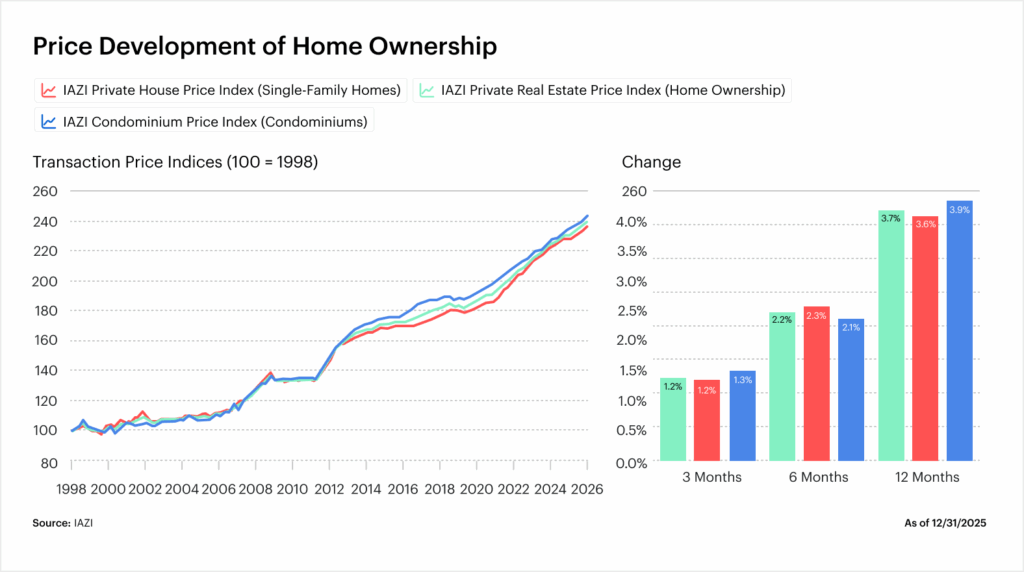
Market conditions: How is the current local real estate market developing? In areas with high demand and rising real estate prices, a sale can be more lucrative. In stable or growing rental markets, on the other hand, letting could be more advantageous. Find out in detail about demand and price trends in advance.
IAZI Real Estate Indices (formerly SWX IAZI Real Estate Indices)
Personal financial situation: The decisive factor is whether capital is needed in the short term or whether regular income is the priority. Rental income can contribute to income security, but is not completely risk-free. Vacancies, maintenance and provisions must also be taken into account.
Future plans: If you want to keep an open mind – for example for later owner-occupation or a sale at a later date – you will often opt for renting. If you have clear prospects and a desire for financial simplification, selling may be the better solution.
Resources: Do you have enough time and experience? A rented property requires ongoing support. Tenancy law, maintenance and tenant communication take time and experience. External management also incurs costs and ties up resources.
Selling a property: What are the advantages?
Die aktuelle Situation auf dem Immobilienmarkt zeigt eine fortlaufende Dynamik, die sich je nach Region und Wirtschaftslage unterscheidet. In this environment, the decision to sell a house is often characterized by the prospect of attractive sales prices. Property owners may see a good opportunity to realize their capital and benefit from the current market conditions.
The following points speak in favor of selling your home:
Capital: A house represents a significant capital investment, especially in sought-after Swiss metropolitan regions such as Zurich, Basel or Geneva. Selling allows homeowners to release tied-up capital, which is particularly useful when costly investments or life changes are imminent.
Attractive market situation: The current market situation is an important factor. When real estate prices rise, this could be the ideal time to sell your home.
Facilitation: Maintaining and managing a property requires time, resources and effort. Selling your home can be a relief, especially if your responsibilities as an owner no longer fit in with your current lifestyle or if the property is no longer being used as a vacation home.
Life circumstances change: Changes in life such as a new job or family events as well as personal needs can make it necessary to sell a house in order to adapt to new life circumstances.
Management: No time and resources for managing a rental.
Renting out a property: What are the advantages?
But what if the property has not yet been sold and is to be rented out (for the time being)? The advantage of renting is that the real value of the house protects you from inflation, but you can expect annual depreciation. Another advantage of renting is that you have a regular and predictable income, also in terms of retirement provision. And if real estate prices rise significantly again in the next few years, profits can be recorded.
The following points speak in favor of renting out the property:
Yield from rental income: Renting out a house enables homeowners to generate rental income.
Profits through value appreciation: Letting also allows you to benefit from a long-term increase in the value of the property.
Flexibility: Renting offers flexibility, especially if life circumstances change and a return to the property may be possible in the future.
Conclusion
The decision to sell or rent a property depends on the market, goals and personal situation. In 2026, the Swiss real estate market offers stable conditions for both options. The decisive factor remains an objective analysis rather than a purely emotional decision.
A well-founded valuation and structured advice help to realistically assess opportunities and risks. properti supports owners with digital tools, market knowledge and personal support – from the initial assessment to implementation.
FAQ Renting or selling a property
What makes more financial sense: selling or renting out a property?
Whether it makes more financial sense to sell or rent depends heavily on the individual starting position. A sale creates immediate liquidity and allows tied-up assets to be used in a targeted manner – for example for retirement planning, new forms of housing or investments. Renting, on the other hand, can generate stable income in the long term, but requires provisions for maintenance, vacancies and administration. The decisive factor is the comparison between one-off sales proceeds and long-term net yield after costs. A professional valuation forms the necessary basis for this.
What are the risks of letting and how can they be assessed?
In addition to income, a rented property also entails obligations. The most common risks include vacancies, non-payment of rent, unexpected maintenance costs and legal issues in the tenancy. These risks can be reduced, but not completely eliminated. A realistic rent calculation, careful tenant selection and sufficient provisions are crucial. In addition, it should be checked whether there is time and willingness for ongoing management or whether external management makes sense.
When is the right time to sell or rent out a property?
The right time is determined by the interplay of the market, life stage and personal planning. Rising prices or high demand can favor a sale, while a tight rental supply enables stable income. At the same time, personal factors play a key role: changes in everyday life, the desire for simplification or new living requirements influence the decision at least as much as market data. If you want to choose the right time strategically, you should analyze the market value, prospects and alternatives at an early stage.
All data are without guarantee. The information on these Internet pages has been carefully researched. Nevertheless, no liability can be assumed for the accuracy of the information provided.