


|
Getting your Trinity Audio player ready...
|
Key facts:
- US tariffs of up to 39% hit export-dependent sectors and have an indirect impact on real estate markets
- Commercial real estate in industrial regions could come under demand pressure in the medium term
- Low interest rates, strong domestic demand and stable sector clusters support residential real estate prices
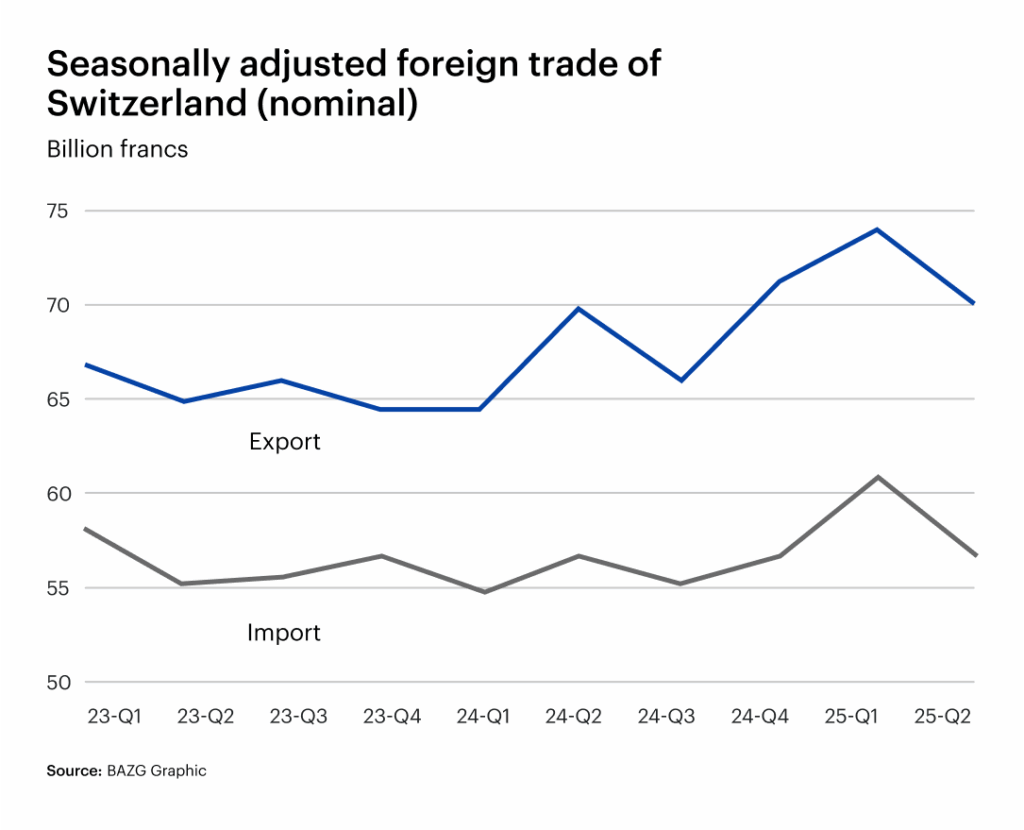
The introduction of US tariffs of up to 39% on Swiss exports on August 1, 2025 marks a turning point in international trade. This means more uncertainty for the Swiss economy, and the real estate market will also indirectly feel the consequences. Property owners are well advised to be aware of the regional and market-related effects – not only in order to assess risks, but also to take advantage of opportunities in a changed environment.
What is the impact of US tariffs in Switzerland?
Export-oriented sectors such as mechanical engineering, precision instruments, watchmaking and processed foods are particularly affected by the US tariffs. Companies in these sectors are facing higher production costs, falling demand from the US and changes to their supply chains. This may also have consequences for the real estate sector: Expansions of production and logistics space are being planned more cautiously, there are fewer rental agreements in the commercial sector and new construction or development projects may be delayed.
As many commercial properties are owned by companies, rental prices will remain stable in the short term. In the long term, however, the pressure to invest could ease – an aspect that owners of such properties should consider at an early stage.
What do the US tariffs mean for residential real estate?
The economic slowdown is also having an impact on residential real estate. A possible slowdown in population growth and a weaker labor market could dampen the willingness to pay in individual regions.
At the same time, markets with stable sectors, such as life sciences in Basel or financial services in Zurich, remain largely resistant. Here, sustained demand is preventing a noticeable fall in prices.
Can low interest rates support the real estate market?
The Swiss National Bank lowered the key interest rate to 0% in June 2025, a direct response to weak inflation and global uncertainty. This has several advantages for owners:
- Attractive financing: Buyers can finance on favourable terms, which stabilizes demand.
- Greater liquidity in the market: investors and private buyers have more scope for transactions.
- Stabilization effect: Even in economically weaker regions, low interest rates can cushion price pressure.
Which regions are particularly affected?
Not all locations react equally sensitively to the new trading conditions. Industrial locations, agricultural regions and smaller centers with a high proportion of manufacturing are particularly exposed. On the other hand, service and financial centers such as Zurich or Geneva and tourist regions that are hardly dependent on US trade are less susceptible. Against this backdrop, regional market analyses are becoming increasingly important in order to specifically assess opportunities and risks and recognize developments at an early stage.
Inflation, construction costs and renovations
The restructuring of supply chains could increase material prices in individual areas. At the same time, overcapacity and a weaker economy are keeping price pressure low. The inflation forecast is 0.2% for 2025 and around 0.7% by 2027.
This means for owners:
- Construction and renovation costs remain largely stable
- Targeted modernization can be planned in this environment
- Longer project durations possible due to more cautious investors
International demand: a continuing stability factor
Despite tariffs and trade disputes, Switzerland remains an attractive market for international investors. Take Andermatt, for example: over 1,260 inquiries and CHF 14.2 million in advance payments from US buyers in the first half of 2025 – almost twice as much as in the previous year.
High-quality real estate in sought-after locations can benefit from this demand, regardless of short-term economic fluctuations.
Conclusion: What the US tariffs mean for real estate
The US tariffs in 2025 may bring uncertainty, but the fundamental strength of the Swiss real estate market remains intact. For owners, this means that anyone planning to sell their property will continue to benefit from stable demand in attractive regions and the low interest rate environment. The key is to assess the situation correctly and prepare the sale strategically. In this way, values can be secured and in many cases even additional opportunities can be realized.
FAQ
How much can US tariffs affect real estate prices?
The effect depends heavily on the type of property and the regional economy. Commercial and industrial properties in export-dependent regions feel the pressure first, for example through falling demand for space and companies’ reduced willingness to invest. Residential properties are more robust, especially in economically strong conurbations or tourist regions, where demand remains stable even in difficult times.
Which regions are most affected by the US tariffs?
Industrial locations on the Central Plateau, parts of Eastern Switzerland and areas dominated by agriculture are particularly vulnerable. A weaker order situation there can lead to job losses, which has a direct impact on the demand for housing. By contrast, cities with a high proportion of services, such as Zurich, Basel and Geneva, as well as established tourist regions, are largely resistant.
Could low interest rates stabilize the real estate market?
Yes, on several levels. Low financing costs increase the attractiveness of purchases and facilitate the refinancing of existing mortgages. This not only supports prices, but also ensures that transactions continue to take place. It can therefore make sense for owners to review existing loans and, if necessary, benefit from more favorable conditions.
Data are without guarantee. The information on these Internet pages has been carefully researched. Nevertheless, no liability can be assumed for the accuracy of the information provided.