



|
Getting your Trinity Audio player ready...
|
Key facts:
- In 2026, buyers in Switzerland will benefit from stabilized real estate prices and a very low key interest rate environment.
- Energy efficiency, maintenance costs and value retention are weighted more heavily than in 2020.
- Financing remains viable. Banks continue to calculate with imputed interest rates.
Do you remember 2020? High dynamics, rising prices, pressure to make decisions.
Buying real estate in Switzerland in 2026 looks different. According to data from the Federal Statistical Office and analyses by Wüest Partner, price trends have slowed significantly in many regions. At the same time, the key interest rate of the Swiss National Bank at a low level. Buying is more predictable again. But quality, energy efficiency and long-term sustainability have become more important.
Step 1: Set a realistic budget – ensure long-term financial sustainability
Realistic budget planning is still the first step when buying a property in 2026. Equity, income and long-term obligations must be carefully analyzed.
Banks expect higher imputed interest rates despite low market interest rates. This protects against overcharging, but requires solid preparation. Affordability is the decisive factor.
The following must be taken into account:
- At least 20% equity
- Ancillary costs of around 3-5% (varies from canton to canton)
- Ongoing maintenance costs of approx. 1% per year
Further insights into financing a property can be found here. A financial buffer remains crucial in 2026, especially for older properties that may require renovation.
Step 2: Search for a property – energy is crucial to buying
The search for real estate today is less hectic than in the boom years. Nevertheless, a clear positioning remains important: Which region is right for you? Which infrastructure? What stage of life are you in?
In addition to the situation, the following aspects will come more into focus for many in 2026:
- Energy performance certificate (GEAK)
- Condition of heating and insulation
- Potential for future renovations
- Development of the neighborhood
A property is not only living space, but also a capital investment. You should therefore not only assess its current condition, but also the prospects for the next 15-20 years.
Digital platforms, search subscriptions and professional support significantly increase the probability of finding the right property – especially for properties that have not been publicly advertised for long.
Step 3: Inspection – check the substance, not just the atmosphere
A viewing should not only be emotional, but also analytical. Take your time and examine the property systematically. Daylight, sense of space and surroundings are important, but so are technical details.
Check at every inspection:
- Facade, roof and windows
- Moisture or cracks
- Condition of the heating
- Background noise at different times of day
In the case of older properties, we recommend a second inspection or the assistance of a specialist. This will give you a realistic assessment of possible investments.
Step 4: Check documents and land register
Before you make a binding commitment, all documents should be available in full. An extract from the land register provides information about the ownership structure and possible encumbrances. Also relevant are
- Renovation and refurbishment certificates
- Protocols for condominiums
- Status of the renewal fund
- Zoning plan of the municipality
In 2026 in particular, comprehensive information will significantly reduce risks.
Step 5: Negotiate price – argue based on data
After careful examination, the price negotiation follows. In the current market environment, there is more room for maneuver than in the boom years, but your arguments should still be structured and fact-based.
Base your offer on comparable properties in the region, the condition of the property, specific investment or renovation requirements or the quality of the location and micro-location If major investments are due in the foreseeable future, this should be included in your offer. At the same time, realism is crucial: a market-driven, comprehensibly justified asking price signals seriousness and increases the chances of reaching an agreement.
Step 6: Secure binding financing
Once the purchase price has been agreed, you will need a binding financing commitment. This will show whether your plans are viable in the long term. The bank will once again check your income, equity and affordability – even assuming a higher imputed interest rate.
Discuss this with your bank in particular:
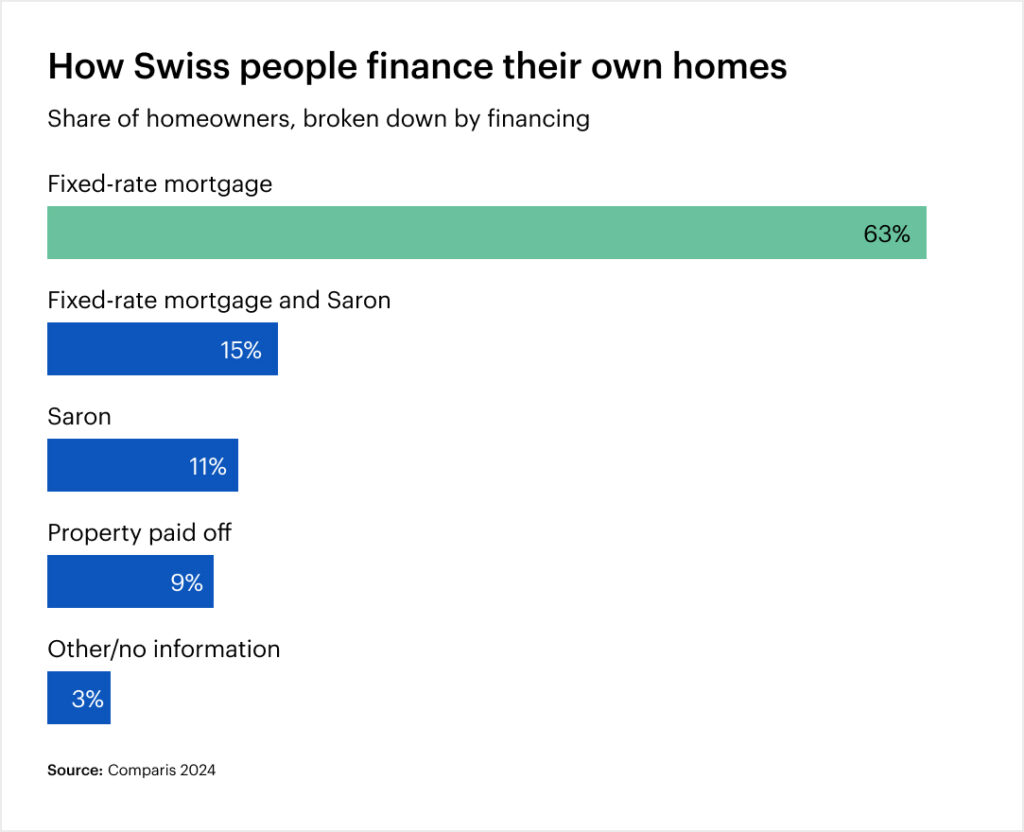
- Choice of mortgage model (e.g. fixed-rate mortgage or SARON)
- Terms and possible scaling
- Amortization strategy
- Protection in the event of changes in income or family planning
Even in the low interest rate environment of 2026, financing must not only be affordable today, but must also be sustainable in the event of changing life circumstances or rising interest rates. A well thought-out structure creates long-term security.
Step 7: Check the purchase contract
The purchase contract is not a formality, but a binding obligation. Take your time to check the draft.
Pay attention to:
- Exact purchase price regulation
- Clear payment terms
- Handover date
- Warranty issues
With your signature, you undertake to pay the purchase price. In return, the seller undertakes to hand over the property after payment. The notary then takes care of registering the priority notice of ownership in the land register so that your claim is legally secured.
This step is crucial – check carefully.
Step 8: Notary appointment and registration of ownership
The notary appointment is more than just an administrative act. This is where the contract is publicly notarized and thus becomes legally binding. Both parties appear in person and identify themselves. The notary reads out the contract or summarizes it in a structured manner. Use this moment to address any final ambiguities. Changes are possible until the contract is signed.
After the signature:
- If the notary notarizes the contract
- Applies for a priority notice of ownership in the land register
- Coordinates the next steps until the purchase price is due
The priority notice is central. It legally secures your claim to transfer of ownership, even if the purchase price has not yet been paid.
Step 9: Payment of the purchase price and entry in the land register
Following the notary appointment, you will receive the so-called due date notice from the notary. Only then can the purchase price be transferred. In practice, this means that the bank pays out the mortgage in accordance with the financing plan, your equity is contributed and the purchase price is transferred to the notary’s escrow account or directly to the seller.
Further costs are incurred at the same time:
- Notary fees
- Land register fees
- Transfer tax (regulated differently depending on the canton)
As soon as receipt of payment is confirmed, the notary will arrange for the definitive transfer in the land register. Only with this entry are you not only the owner, but also the legal owner of the property. This step marks the legal conclusion of the real estate purchase.
Step 10: Handover and moving in
The handover takes place with a detailed protocol. Meter readings, keys and any defects should be documented.
Only then does the new chapter in home ownership begin – with structured preparation and legal security.
What was reweighted in 2026?
Compared to 2020, there is a greater focus today:
- Energetic condition of the property
- Long-term operating costs
- Financing in the low interest rate environment 2.0
- Location quality in a regional context
Conclusion: Buying real estate in Switzerland in 2026 – easier to plan, but challenging
Buying real estate in Switzerland in 2026 offers more stability again. Low interest rates and normalized prices create attractive framework conditions. At the same time, sound analysis, sustainable financing and energy efficiency are crucial for long-term value retention.
A structured process ensures that a major decision becomes a sound investment.
FAQs The path to home ownership in 10 steps
Is 2026 a good time to buy real estate in Switzerland?
The real estate purchase 2026 Switzerland takes place in a stabilized market environment with low key interest rates. Many regions are seeing constant prices instead of strong growth. Those with sufficient equity and long-term planning are currently finding more predictable conditions than just a few years ago.
How long does it take to buy real estate in Switzerland today?
Buying a property in Switzerland in 2026 takes several weeks to a few months, depending on the property and financing. In practice, it usually takes 6 to 12 weeks between viewing, financing commitment, notary appointment and entry in the land register.
What additional costs are incurred when buying real estate?
In addition to the purchase price, there are additional costs for the notary’s office, land register and – depending on the canton – transfer tax. In total, around 3-5% of the purchase price should be factored in. Added to this are relocation, insurance and possible renovations.
Why is energy efficiency more important than before when buying real estate in 2026?
Today, energy efficiency not only influences operating costs, but also market value and affordability. Properties with modern heating technology and good insulation retain their value in the long term and incur lower ancillary costs.