


|
Getting your Trinity Audio player ready...
|
Key facts:
- The national vacancy rate is only 1.08% – living space remains scarce.
- Densification, addition of storeys or replacement buildings create added value on existing space.
- Proven expansion potential can increase the sales price by up to 15%.
Switzerland is facing a challenge: the housing shortage is worsening, particularly in urban centers such as Zurich, Basel and Geneva. The vacancy rate nationally is 1.08%, in Zurich city it is only 0.07% . This is the lowest figure in Switzerland. At the same time, construction activity remains at a historic low, which is further widening the supply gap.
Attractive opportunities are opening up for owners and investors in this environment: targeted measures such as densification, adding storeys, replacement buildings or conversion can not only create urgently needed living space, but also realize significant increases in value.
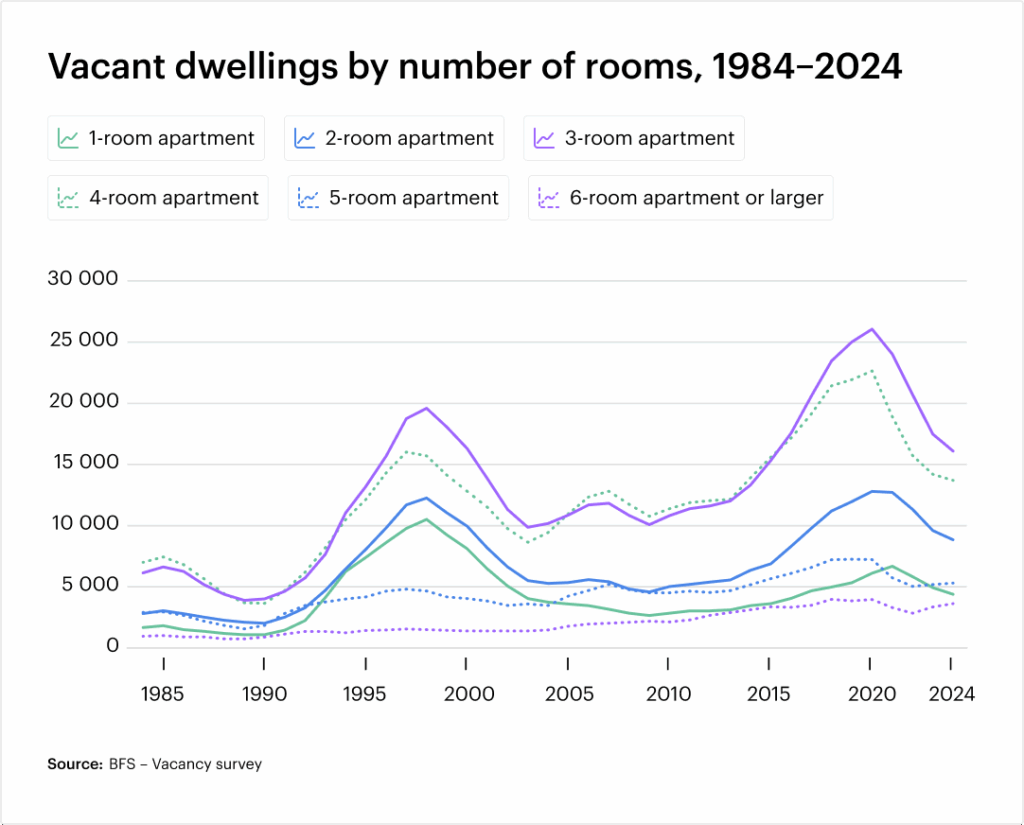
The housing shortage is further exacerbated by population growth due to immigration. In 2024, the population in Switzerland grew by 86,600 people. In the same period, around 38,000 apartments were completed. Against this backdrop, the focus is shifting to the question of how existing properties can be used more efficiently.
Densification: activate unused areas
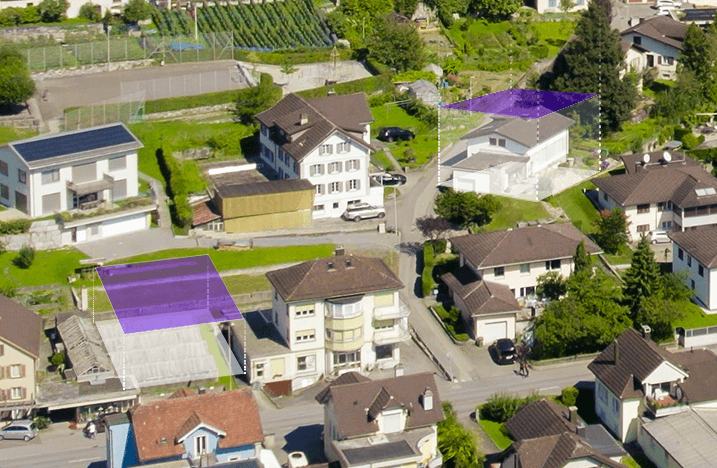
In many municipalities, there are building reserves that have so far remained unused. Properties with single-family homes or older apartment buildings on large plots often offer space for additional residential units, for example through extensions, backyard development or splitting.
According to ETH studies, up to 30% more apartments could be created in Swiss cities through inner densification without the need for additional floor space. Cities such as Basel, Bern and Lucerne have already adjusted the utilization rates or introduced simplified procedures to facilitate the realization of such potential.
Addition of storeys: New areas above existing buildings
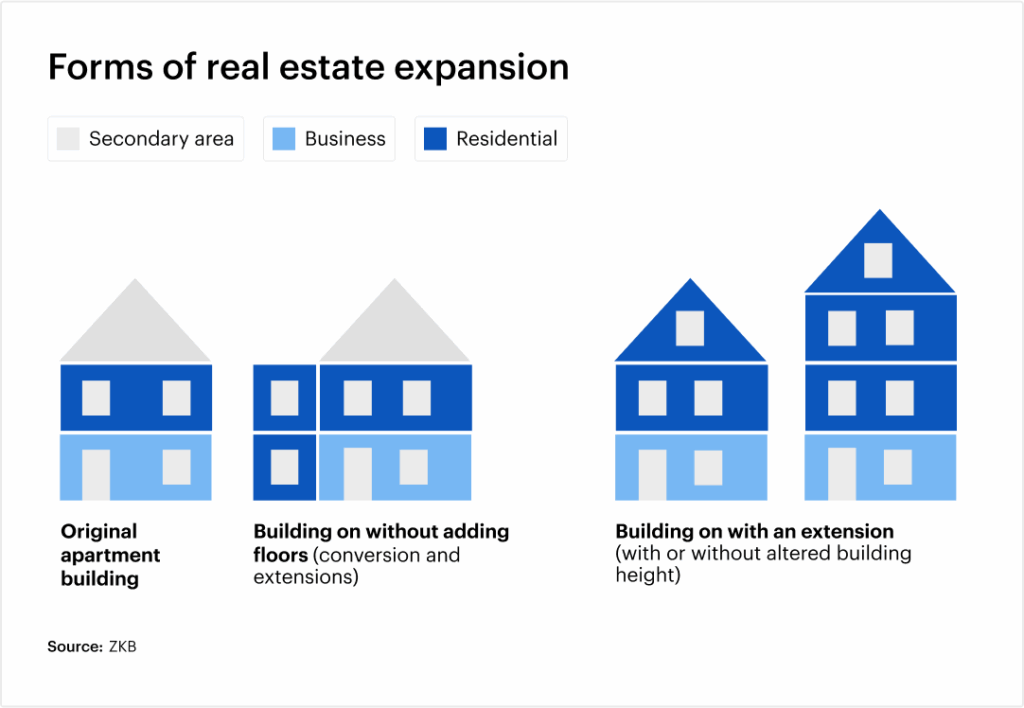
Many apartment buildings, especially those built between the 1960s and 1980s, were built with excessive structural dimensions. Today, this opens up new perspectives. In many cases, it is possible to add one or two additional storeys – using prefabricated timber modules, for example.
Especially in the Zurich, Winterthur and Lausanne regions, where building land is scarce, vertical expansion is becoming an increasingly attractive model. For owners, an extension not only means additional rental space, but also a long-term increase in property value. In many places, building and zoning regulations already permit these measures or are currently being revised in favor of such projects. A precise potential analysis with a structural analysis is essential for this.
Note: Particular caution is required in the case of listed buildings or in places worthy of protection. In such cases, structural changes, such as adding storeys or adapting facades, are only possible under strict conditions. It is advisable to consult the relevant monument preservation authorities at an early stage to clarify the feasibility and the necessary approvals.
New replacement building: more residential units on the same area
Not every building is a case for renovation. Older properties in particular, which are no longer energy-efficient or can hardly be adapted structurally, can develop significantly more potential in a new replacement building.
A new build makes it possible to create modern floor plans and make full use of the plot. At the same time, requirements such as accessibility and energy efficiency must be met. For institutional investors, new replacement construction can also be used strategically. For example, through forward deals or by combining it with publicly subsidized housing, which is politically desirable and facilitates market access.
Strategically utilizing potential for sales
For potential buyers, project developers, institutional investors or housing cooperatives, it is not only the current condition that counts, but above all the future development potential. A property with proven development potential, e.g. through preliminary building law clarifications or rough concepts, often achieves higher sales prices than comparable properties without proven reserves.
According to market analyses, the sales price can increase by up to 15% if the development potential is documented and ready for approval. Transparent preparation is crucial: visualizations, feasibility studies and confirmations from the municipality significantly strengthen the basis for negotiation.
Conclusion: Recognize development potential – and use it for more living space
The creation of additional living space has become a task for society as a whole, while at the same time offering new opportunities for owners and investors. Anyone who knows and can prove the structural possibilities of their property – whether through densification, adding extra storeys or building a new replacement – creates added value for future residents and in the sales process. In a market environment with high demand and low supply, documented potential is a decisive advantage.