


|
Getting your Trinity Audio player ready...
|
Key facts:
- Historically low vacancy rates: In many cities, the vacancy rate will be well below 1% in 2026, which will further intensify competition on the rental market.
- Structural causes instead of short-term effects: High levels of immigration, changing household structures and too little new construction activity meet slow approval procedures and rising construction costs.
- Ongoing price pressure: asking rents in metropolitan areas are expected to rise by 3-5% in 2026, while relief from new construction is only expected in the long term.
The housing crisis in Switzerland has evolved from a temporary market phase into a structural challenge. What was long considered a problem in individual cities will affect large parts of the country in 2026 – especially urban centers and their agglomerations. This means increasing competitive pressure for tenants, changing market logic for owners and an increasing need for action on the part of politicians.
The housing crisis in Switzerland in figures
A housing crisis occurs when the supply of housing no longer meets demand in the long term. In Switzerland, this is reflected in very low vacancy rates, rising rents and limited availability of rental apartments, particularly in cities and conurbations.
According to the definition of the Federal Statistical Office, a housing market is considered to be under pressure if the vacancy rate falls below 1.5%. This figure was recently around 1% across Switzerland, but significantly lower in cities.
Regional differences (selection)
| Region | Vacancy rate | Market character |
| Zurich City | < 0,5% | Acute shortage |
| Geneva | ~ 0,3% | Lowest value in CH, chronic housing shortage |
| Basel-Stadt | ~ 0,7% | Supply deficit |
| Bern City | ~ 1,0% | Very tense |
| Peripheral regions | > 1,5% | Partially balanced |
Further information on the vacancy rates for all cantons can be found here . The housing crisis is not homogeneous across the country, but is concentrated where jobs, education and infrastructure come together.
The structural causes of the housing crisis
1. demographics and household structures
Switzerland is growing – not only due to immigration, but also due to changing lifestyles. Smaller households, more single-person households and longer lifespans are increasing the amount of space required per capita. Even with moderate population growth, the demand for living space is increasing disproportionately.
2. construction activity under structural pressure
Although demand is high, new construction activity is lagging behind the necessary level. The reasons for this include
- Construction and financing costs
- Lack of planning security for investors
- Falling yield expectations for rental apartment projects
Although the low interest rate at the Swiss National Bank has a stabilizing effect on the real estate market as a whole, it does not compensate for the cost increases in construction.
3. approval and objection practice
A major bottleneck lies in the planning process. Planning applications often take several years to be realized. Objections, conditions and political conflicts between densification and neighborhood preservation delay urgently needed living space.
4 Regulatory conflicts of interest
Switzerland is pursuing ambitious environmental and noise protection targets. At the same time, building density is to be increased. In practice, this often means that land may not be used to its maximum potential, despite the need for living space.
Swiss rental market 2026: How the housing crisis is changing prices and behavior
The rental market is at the center of the housing crisis in Switzerland 2026. Current market analyses show that the shortage is not only reflected in rising prices, but also in changing market mechanics.
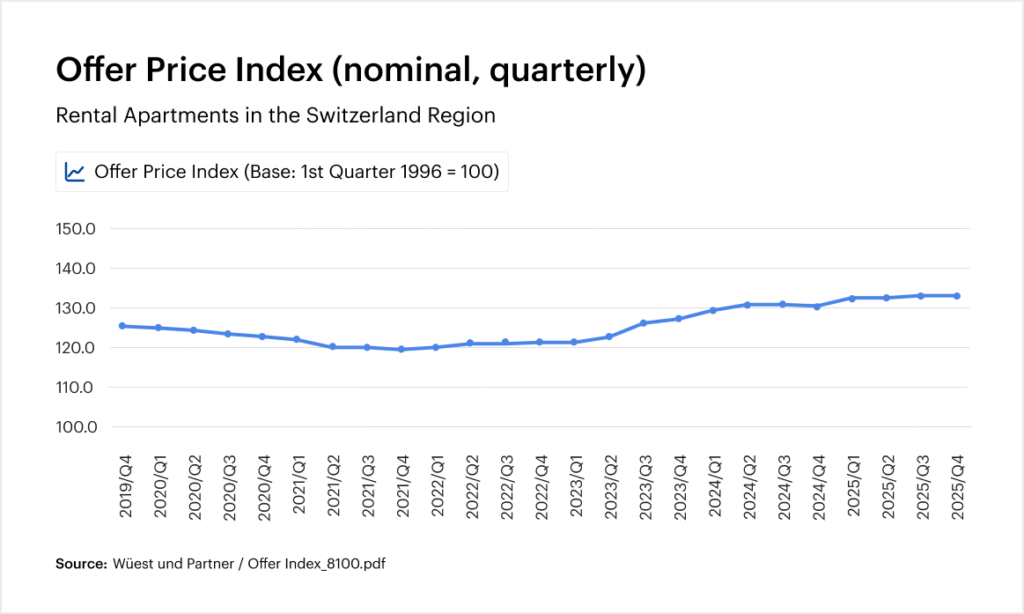
Asking rents react directly to the shortage. In urban regions, they will continue to rise by around 3-5% in 2026, driven by a lack of new construction, high demand and falling relocation frequency. Existing rents will follow with a time lag. Although regulatory requirements and the reference interest rate are having a dampening effect, rising maintenance and operating costs are increasingly leading to adjustments.
A central, often underestimated effect is the decline in residential mobility. Households remain in existing tenancies for longer because there are no alternatives or they are significantly more expensive. As a result, less housing is coming onto the market. This is therefore a self-reinforcing bottleneck.
Market effect: A permanently tight rental market stabilizes the demand for home ownership. Even with high entry prices, buying remains a viable alternative to renting for many households.
Consequences for apartment seekers: A market with new rules
The housing crisis is not only changing prices, but also the mechanics of housing allocation.
Applications are becoming more professional – not optional, but necessary
Standardized forms are no longer sufficient in many cities. Landlords expect complete, digital dossiers with verified creditworthiness, a clear household structure and transparent communication. The selection process increasingly resembles pre-selection, especially for properties that are in high demand.
Off-market gains in importance
A growing proportion of lettings are taking place before the public tender. The reasons for this are efficiency, less administrative effort and targeted selection. For apartment seekers, this means that networks, administrations and professional brokerage structures are becoming more important than pure portal searches.
Alternative forms of housing as a pragmatic response
Home swaps, temporary interim use and co-living are no longer marginal phenomena. They arise as a functional reaction to scarcity, especially in urban, mobile households or during transitional phases in the life cycle.
Owners’ perspective: high demand, new framework conditions
From an owner’s perspective, the 2026 housing crisis will lead to a market environment with a clear demand base. At the same time, the framework conditions for letting are changing. The focus is not on restrictions, but on new requirements in terms of structure, processes and market understanding.
Instead of pure scarcity logic, quality, transparency and efficiency are gaining in importance. Owners who actively take this development into account benefit from stable demand and predictable letting processes.
What will change for owners in concrete terms
| Division | Development in the market |
| Demand | High and stable demand for rental apartments |
| Selection processes | More structured screening of prospective tenants |
| Regulation | Clearer requirements for documentation and processes |
| Expectations | Focus on traceability, quality and fairness |
| Rental period | Shorter with professional installation |
What role does technology play in the housing crisis?
Technology cannot solve the structural housing shortage, but it does influence how efficiently housing is used, brokered and managed. In a tight market, it is not the side with the most properties that wins, but the one with the clearest processes and the best information.
Digital tools enable more precise coordination between supply and demand, reduce administrative work in the initial letting process and increase transparency in pricing and decision-making processes. These efficiency gains have a stabilizing effect, especially in tight markets, because they avoid vacancies and accelerate lettings.
Real estate companies such as properti use technology as a targeted working tool: to analyze market data, to structure letting processes and to support well-founded decisions for owners and tenants. Technology does not replace professional evaluation or market knowledge, but complements it where complexity and volume increase.
Conclusion
The housing crisis in Switzerland 2026 is the result of long-term structural developments. Low vacancy rates, high demand and delayed construction activity are having a lasting impact on the market. Short-term relief is not foreseeable – making transparent market information, realistic pricing strategies and efficient processes along the rental chain all the more important.
FAQ:
Why is the housing crisis more severe in 2026 than in previous years?
The current housing crisis is structural in nature. Population growth, smaller households and too little new construction activity are combined with long approval procedures and rising construction costs. Unlike previous bottlenecks, there is no short-term relief in sight.
Will rents in Switzerland continue to rise in 2026?
Yes. Market analyses assume that asking rents in metropolitan areas will continue to rise in 2026. Existing rents will react with a delay, but will also remain under upward pressure, partly due to cost increases and the reference interest rate.
When will the housing market in Switzerland ease again?
No widespread easing is expected in the short term. Even if construction activity increases, new apartments will only have a delayed effect. Noticeable relief is not expected until the end of the decade at the earliest – depending on construction volumes and regulatory adjustments.
What does the housing crisis mean for real estate prices?
A tight rental market stabilizes the demand for residential property. High rents increase the attractiveness of buying, which limits price-dampening effects in the property market, particularly in regions with strong demand.
Can technology solve the housing crisis?
Technology cannot solve the housing shortage, but it can make processes more efficient. Digital letting, data-based pricing and structured processes help to find available housing more quickly and accurately.
Is the housing crisis a purely urban problem?
No. Although it is particularly pronounced in cities, the pressure is increasingly spreading to agglomerations. In peripheral regions, the market is more balanced in some cases, albeit with lower demand.
What role does government intervention play in the housing crisis?
Regulatory framework conditions have a strong influence on supply and construction activity. Approval procedures, zoning and environmental regulations have a long-term effect on the housing market, but do not solve short-term bottlenecks.