



|
Getting your Trinity Audio player ready...
|
Key facts:
- Residential real estate prices rose by 0.9% in Q2 2025 – annual increase currently 3.7%
- Agglomerations and prime locations show the strongest demand, peripheral regions stagnate
- Interest rates remain low (key interest rate 0% since June 2025) – tailwind for buyers and sellers
Real estate prices in Switzerland will continue to rise in 2025. In the second quarter, prices for residential property rose by 0.9% – for the year as a whole, this represents an increase of 3.7%. This raises the key question for owners: is it worth taking advantage of the current demand now, or does it make more sense to sell later?
Real estate prices over the course of 2025 – current figures
The Swiss residential real estate market has shown a clear upward trend since the beginning of the year. According to UBS and the FSO, prices for condominiums and single-family homes continued to rise in the second quarter.
| Quarter 2025 | Change compared to previous quarter | Change compared to previous year | Comment |
| Q1 2025 | +0,7% | +3,2% | Stable start to the year, demand for apartments in particular |
| Q2 2025 | +0,9% | +3,7% | Broad demand, supply bottleneck intensifies |
| Q3 2025 | +0,8%* | +3,9%* | *Preliminary data: Trend remains positive |
| Forecast Q4 | +0,5-1,0% | +2-4% | Moderate but stable continuation |
Source: FSO, UBS (as at September 2025)
Demand, supply and financing
Demand for residential property remains high, particularly in cities and conurbations. Short distances to work and leisure and good public transport connections make these locations particularly attractive. At the same time, supply remains scarce: new builds are being delayed due to high construction costs, a lack of skilled workers and regulatory requirements. Many owners are also holding on to their properties, which is also supporting the price trend. Financing is providing a tailwind: since the SNB key interest rate was cut to 0% in June 2025, mortgages have become cheaper again, which is boosting purchasing power and making it easier to make buying decisions.
Regional differences – where prices are rising, where they are stagnating
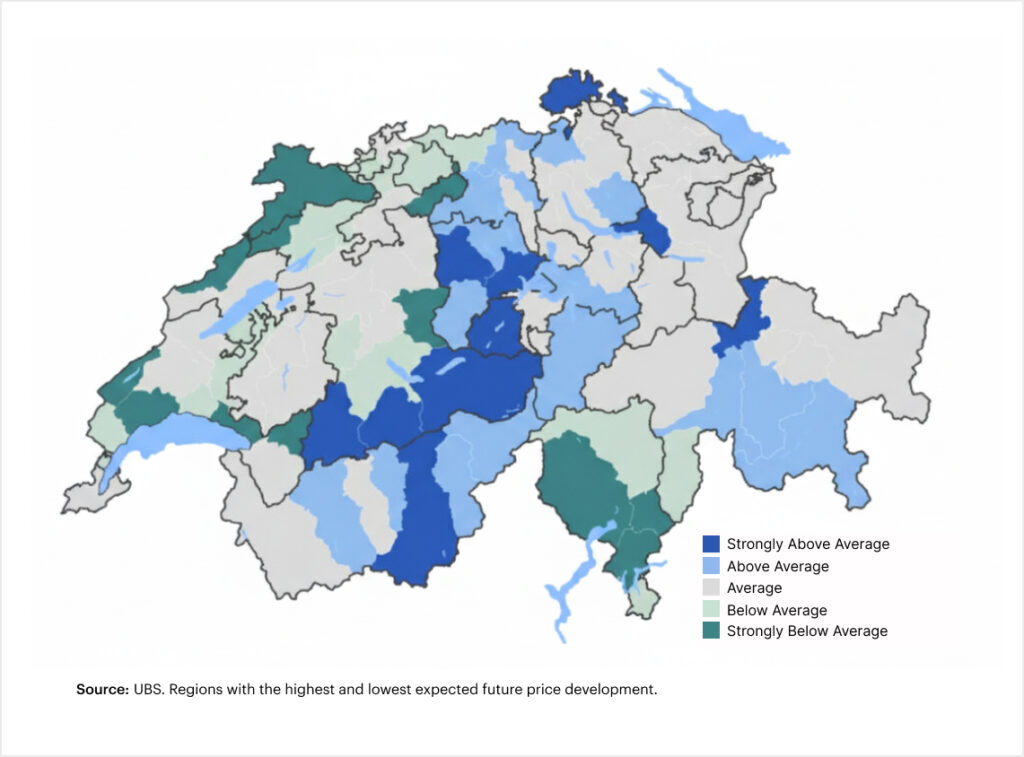
Not all regions are benefiting equally from the upturn. Prices continue to rise in prime locations and metropolitan areas such as Zurich, Basel and Geneva, as well as in areas attractive to tourists such as the Engadin and the Bernese Oberland. Agglomerations with good public transport connections – for example in Aargau or around Lucerne – are also recording above-average growth, as they offer a mix of accessibility and more attractive prices. In peripheral regions without direct connections, on the other hand, demand is stagnating, meaning that prices remain stable but show little potential for growth.
Trends in the residential real estate market 2025
The Swiss residential real estate market in 2025 will not only be shaped by price movements – structural developments and social trends will also have a noticeable impact on demand and supply. Four aspects stand out in particular:
- Shift towards condominiums
Condominiums are in greater demand than single-family homes – they are more affordable, easier to maintain and suit urban lifestyles. - Sustainability as a value factor
Buyers are increasingly paying attention to energy efficiency, modern heating systems and sustainable construction methods. Properties with photovoltaics or good insulation have an advantage. - Demographics and the “silver tsunami“
While some experts expect a wave of sales by older owners, current data shows that many are staying in their homes or passing them on within the family: Many are staying in their homes or passing them on within the family. An overload of the market is not foreseeable in the short term. - Political framework
The vote to abolish the imputed rental value and the introduction of new property taxes on second homes could have an impact on the willingness to sell in the medium term.
Forecast for Q4 2025 – opportunities and risks
Most market analyses expect a further moderate price increase of between 2-4% in Q4. Growth could be higher in prime locations.
Opportunities:
- Attractive sales prices in sought-after regions
- High demand for properties with good infrastructure or sustainable features
Risks:
- Rise in interest rates: If the SNB takes countermeasures in 2026, demand could cool down.
- Tax changes: New regulations could influence sales strategies.
- Oversupply in peripheral locations: Peripheral regions could stagnate or experience slight price corrections.
Conclusion & recommendation for action
The Swiss real estate market will be robust in 2025, with clear advantages for sales in sought-after regions. Owners should actively monitor the market, define clear trigger points and react flexibly to attractive offers. Professional support in valuation and marketing increases the chances of achieving the optimum time and price.
FAQ – Real estate prices in Switzerland 2025
How will real estate prices develop in Switzerland in 2025?
Residential real estate prices will continue to rise moderately in 2025. According to UBS, the year-on-year increase will be around 3.5%. Zurich, conurbations and tourist regions in particular will benefit from continued high demand.
Is it worth selling real estate in 2025 or is it better to wait and see?
In sought-after regions with strong demand, selling is currently particularly worthwhile. In peripheral locations with stagnating prices, it may make sense to wait and see. Location, property quality and personal goals are decisive for the right decision.
What role does the SNB’s key interest rate play for the real estate market?
The stability of the key interest rate ensures affordable financing and supports demand. However, should interest rates rise, the affordability and purchasing power of many households could come under pressure, which could trigger price corrections.
What risks could affect real estate prices in 2025?
The main risks include an unexpected rise in interest rates, an economic slowdown, geopolitical crises and tax changes. In less sought-after regions, an oversupply could also lead to stagnating or slightly falling prices.
Data are without guarantee. The information on these Internet pages has been carefully researched. Nevertheless, no liability can be assumed for the accuracy of the information provided.